Game reviews
Atlas Fallen Review: A Sandy Good Time with Some Coarse Edges
We review Deck 13’s Atlas Fallen to find out what lies beneath this sandy action-RPG.

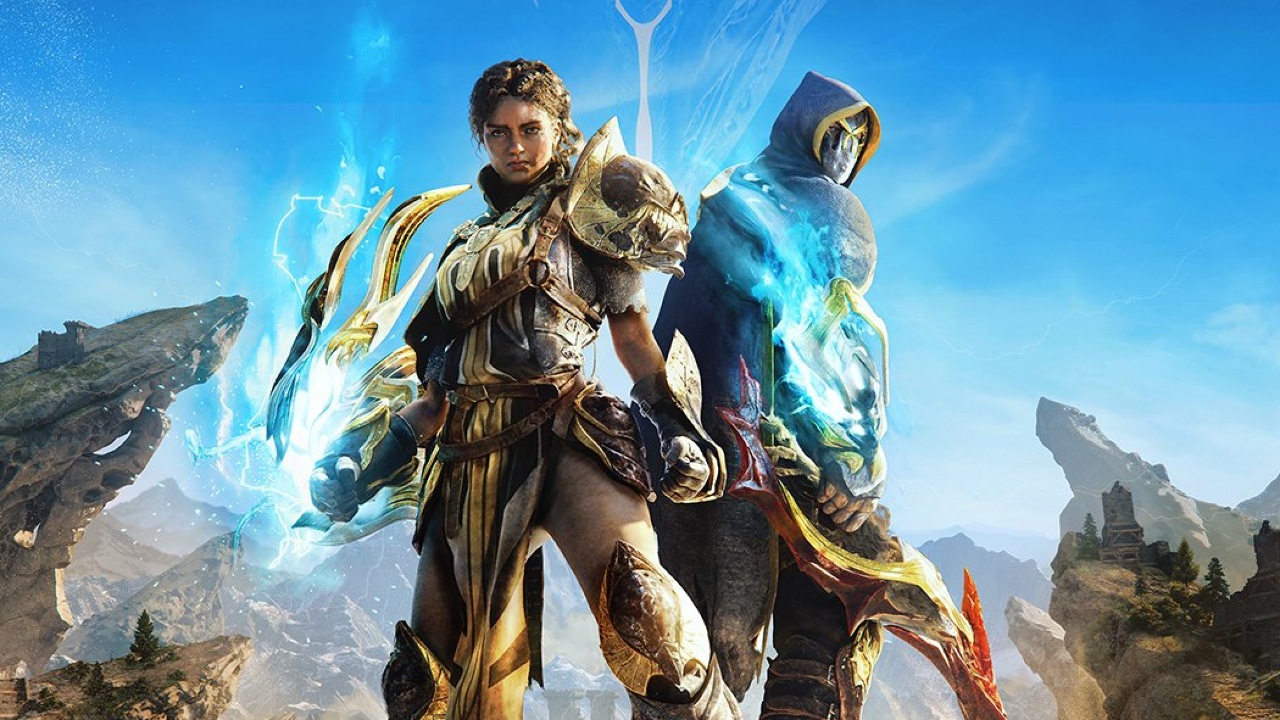
Atlas Fallen is undoubtedly one of the most original (and unexpected) games of 2023, sitting alongside a flurry of remakes, sequels, and remasters that feel very familiar. The Surge and Lords of the Fallen developer Deck 13’s action-RPG has been flying under the radar since its announcement, and after indulging in its sand-laden world, there’s a lot to love about Atlas Fallen, despite some hiccups.
What exactly is Atlas Fallen, though? Not only does the game have a fittingly mysterious and epic title, but the premise is equally as fantastical. In a nutshell, you play as a low-class worker who is chosen to wear a powerful gauntlet, giving you some serious power to fight back against your oppressors and some creatures in this fantastical land. At the core of it, Atlas Fallen is basically a semi-open-world action game with some pretty-deep RPG mechanics, but the real ‘hook’ is that the game is set in a world engulfed in sand.

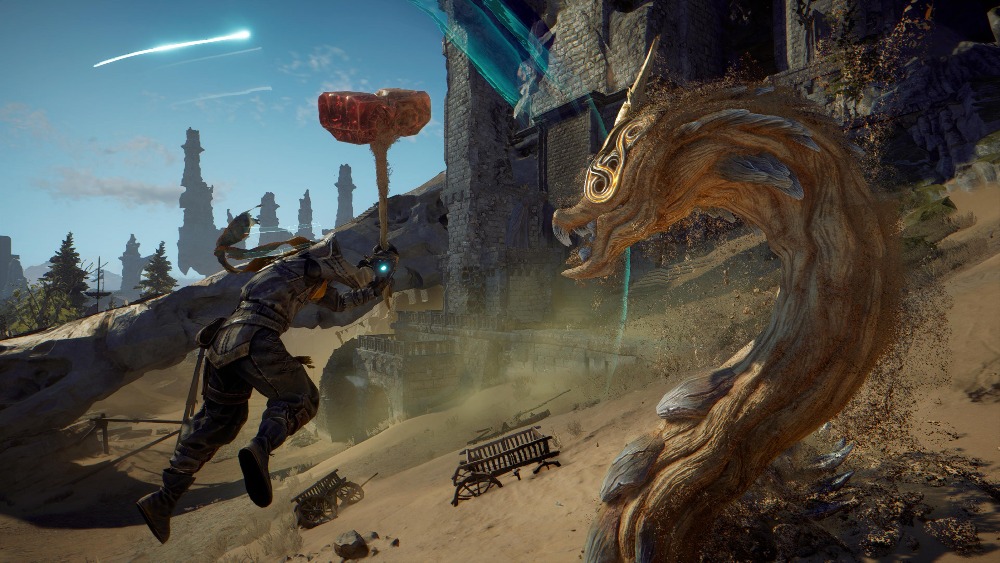
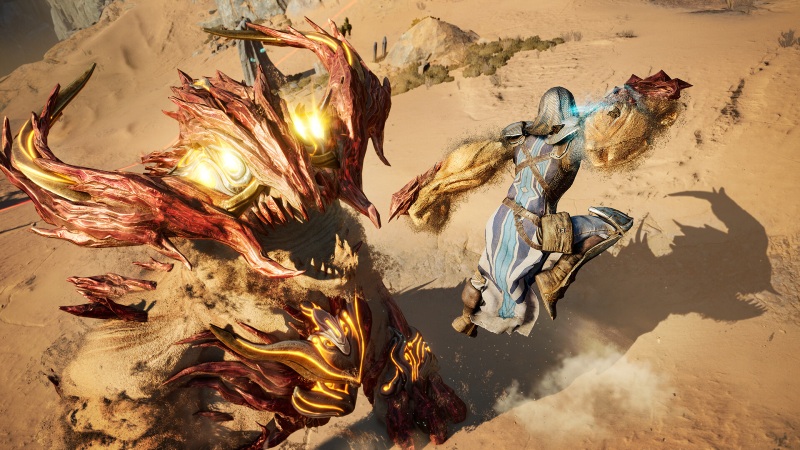
This means that the environments, enemies, weapons, and powers are all centred around the use of sand, which is a pretty novel idea. From fighting giant sand creatures (which are spectacular) to forging axes, blades, and whips out of the sand, there are some incredibly unique concepts utilising the desert-like environments.

As for the combat itself, Atlas Fallen does give you a lot to play with. You have light and heavy attacks, and can alternate which weapons you want each button to correspond with. Verticality plays a role too, and you can volley smaller enemies into the air or get higher up to take on the larger baddies. Additional Momentum abilities allow you to summon a sandstorm, launch a giant sand hammer, and other options too, which all have cooldowns and can be tinkered with to suit your play style.

A handy parry move is also available, and it has a great twist to it. Instead of knocking the enemy’s attack away, you turn to stone temporarily, which then freezes the enemy for a few seconds after they strike you, allowing you to launch a counter-attack.
The combat is fairly challenging, and the evasion and parry windows are very small, but subtle visual cues (such as enemy eyes lighting up red) make it a game of observe-and-act, which saves it from being a frustrating guessing game. It’s definitely a little slower and not as snappy as something like Devil May Cry, Darksiders, or God of War, but does have its own ‘punchy’ feel, which is welcomed.

Traversal obviously makes up a lot of Atlas Fallen, and thankfully the game does a good job of making you feel as mobile and agile as possible. With a large majority of the world covered in sand (there are other regions), you’re able to ‘slide’ across the world, as you carve your way around like some sort of supernatural fantasy sandboarder — it’s pretty awesome. You also have an air-dash that acts as a temporary glide ability, and the power to lift old ruins out of the sand to create platforming opportunities. The variety of movement abilities on offer really does give the player a ‘superhero-like’ feeling in Atlas Fallen, which obviously again ties back into combat well, particularly with the larger enemies.
Sliding at pace through the sand, leaving into the air using the glide, and delivering some powerful melee attacks to enemies feels seamless, giving you a more acrobatic approach to combat, rather than being a powerhouse. Striking, moving, dodging, and zipping around all while chipping away at your enemy’s health bar captures that David vs. Goliath feeling that taking on the giant sand monsters conjures up.
One of the downfalls of Atlas Fallen is its story, despite the initial intriguing set-up. From the get-go, there’s a lot of deep lore that is thrown your way in the form of some (admittedly) overwhelming exposition moments that do become a lot to take in, especially with all the factions, new terminology, and backstory that you pick up hints of throughout the game.
Thankfully, the world itself is more intriguing to look at than listening to the story, and Atlas Fallen provides quite the spectacle. The fantastic particle effect capabilities of the Unreal Engine 5 sees sand flying everywhere, enemy parts breaking off, and some stunning firework-type effects coming from special abilities. Overall, Atlas Fallen is a very good-looking game and a testament to some of the fantastic enemy and character design that Deck 13 has become known for. Given the scale of the world, there are some rougher parts to the visuals when you really look close, but nothing that hampers the experience.
Being an action RPG, there’s also a lot to do outside of the main quest. You can upgrade your armour using items around the world or purchasing crafting pieces from a merchant, taking on side-missions at one of Atlas Fallen‘s many towns scattered around the map, or explore the world and find hidden tombs and items.
Atlas Fallen is undoubtedly one of the more intriguing games out in 2023, bringing a compelling concept, some interesting combat and traversal mechanics, and franchise potential for the future. However, it does fall into the traps that many games in the genre do, with overbearing dialogue, a convoluted narrative, and some complicated menus. With that said, if you’re a fan of the genre, have some patience, and looking for something different, it’s well worth a try.
Atlas Fallen is available on PS5, Xbox Series X/S, and PC.
Review code provided by ZamZam Distribution on behalf of Focus Publishing.